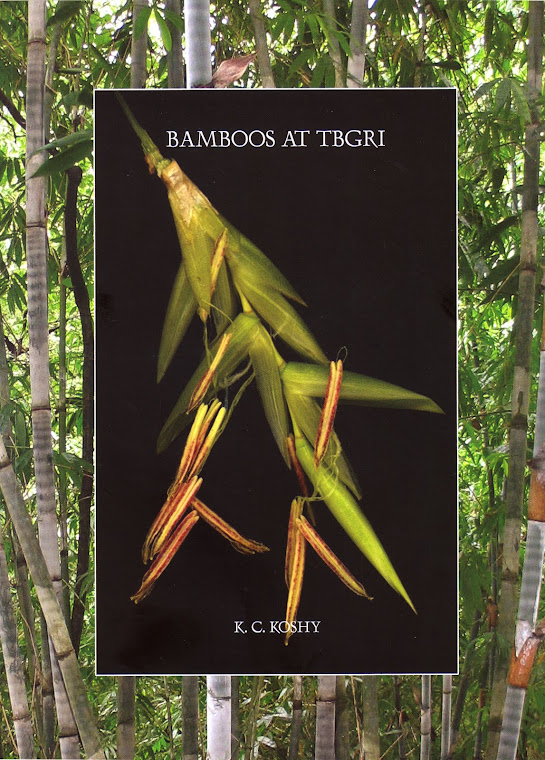
Bamboos at TBGRI

Bamboos at TBGRI
Koshy, K.C.2010

Tuesday, 8 January 2013

Review by Marco Roos in Blumea (57): 195.2012


Blumea (57): 195. 2012

Koshy KC. 2010. Bamboos at TBGRI. Tropical Botanic Garden 
and Research Institute, Kerala, India. 104 pp. ISBN: 978-819-
2009-80-3 (Pb). Price: USD 30.

Bamboos are a notorious group for herbarium taxonomists 
because of their size. The need for living material to map the 
diversity and to be able to make sound species hypotheses, 
usually hampers progress in revision work. It is most helpful if 
botanic gardens built up well-documented collections of living 
plants accompanied by voucher specimens. This very useful 
book provides an excellent example of such an initiative. Apart 
from giving a detailed overview of the specimens and taxa 
present, it also goes into general notions how this collection 
was built up. I think this will be a valuable overview for people 
interested in this impressive group of plants.

Marco Roos

Saturday, 8 September 2012

Schmid· TAXON 60 (1):310.2011(Reviews and notices)

Schmid· Reviews and notices TAXON 60 (1):310.2011

Koshy,K.C. Dec. 2010. Bamboos at TBGRI. Tropical Botanic
Garden and Research Institute, Thiruvananthapuram (www.tbgri
.in). 104 pp., ill. (most col.), col. ep. photos, 276 x 200 mm, ISBN
9788192009803 PB, Rs 800.00 India, US$30.00 foreign. - With
foreword by A. Subramoniam, 3 chaps. (establishing a living coil.;
bamboo resources at TBGRI; sustainable use, future), biblio., acronyms,
glossary, index. Coil. details, other info for 15 gen., 68
spp., 1 var., 12 hybrids. A well-done account w/ excellent photos.

Monday, 28 May 2012

Bangladesh Journal of Plant Taxonomy18(2):209-10.2011

Bangladesh Journal of Plant Taxonomy18(2):209-10.2011-                                            Book review

BAMBOOS AT TBGRI: By K. C. Koshy. Published by the Director, Tropical Botanic Garden and Research Institute, Palode, Thiruvananthapuram 695562, Kerala, India in 2010, Price USD 30(postage free); pp. 104.

This book is a contribution to the documentation of germplasm collection and ex-situ conservation of tropical bamboos. The book contains 104 pages and three chapters.

Chapter 1 deals with TBGRI Bambusetum and major bambuseta of China and India. This chapter provides the historical development of TBGRI Bambusetum with an index map showing contour lines. Notes on the contribution of pioneer scientists who contributed towards the establishment and development of this bamboo garden and dignitaries who visited the Bambuseturn are a special feature of the first chapter. Section on "Advantages of a bambusetum"included in chapter 1 is of good academic interest.

Chapter 2 is the important part and main contents of the book. It includes systematic documentation of live collections of 68 species and one variety under 15 genera, and 12 hybrids produced at TBGRI. The species under each genus are arranged alphabetically. Each species entry includes the Latin name with important citations, a brief description, distributions, records of live collections, locations in the bambusetum with accession numbers. It also records the details of propagules used for planting, their provenances and different hereditary lines conserved. Besides,it provides notes on herbarium collections and spirit materials and notes on flowering where available. Colour photographs of most of the species described, is an important feature of the book that will help all professionals in identifying a living bamboo.

Chapter 3, a brief 2-page chapter with four photographs discusses the future prospects of bamboo breeding.

The identification of bamboos involves more problems than any other group of flowering plants,because most of the bamboos flower once in their life time and die soon after. Flowering of bamboos usually takes place at long intervals (30-120 years). So, identification of bamboos base don floral characters is not always possible. Descriptions based on vegetative characters are also not always complete. Because of identification problem interest in bamboo research is also less among biologists compared to research in other groups. Live collections can help in getting the flowering material that will ultimately help authentic identification and supplying materials for breeding programs. There are bamboo plantations around many organizations, in many home gardens through this sub-continent and in many forest departments' plantations. But systematic information on origin of planting materials, provenances and planting dates are lacking, which are very much needed for methodical research works. TBGRI has taken this novel task of this systematic effort of germplasm collection and conservation. Only who has pursued work on bamboo biology knows how painstaking it is! Dr. K. C. Koshy's efforts in documenting the collections at TBGRI are praise worthy. It will give us a clear picture of flowering and seeding cycles of many bamboo species; genetic diversity among many species and their biology. These collections will also help bamboo taxonomists in documenting vegetative characters along with flowering characters that will make a clear picture of species description. I firmly believe, this book will be good help to taxonomists, breeders, horticulturists and conservation biologists.

There remain some shortcomings in every work. This book also has some shortcomings that need to be mentioned. Use of acronym of an organization in the title of the book could be avoided.TBGRI may not be known to every reader. So, through cross reference one may not know 'what is it or where it is'? It would be clearer if the author had used the full name of the organization and acronym in parenthesis. The map of TBGRI Bambusetum with contour lines and index for accessions is an important feature of the book. But font used in printing accession numbers is too small to be visible in naked eye or by a reading glass. It needs a magnifying glass to read the letters. The map pages also do not open flat and is difficult to read the writings within the fold.

The author could further split Chapter 2. So many entries under a species have made the presentation clumsy. One chapter could be with taxonomic descriptions, geographical distribution and flowering notes. Another chapter could include the accessions of live collections, collection locality, provenances and other information. A key for identification of species based on vegetative characters would make it more users friendly. An auricle of the culm sheath is a good diagnostic character. The author could use it in making botanical descriptions of species.Vernacular names sometimes help general users in tentative identification of a species. The author could cite vernacular names for the species where available.

However, the author is to be congratulated for his painstaking works in collecting and centralizing bamboos from various parts of India and making this documentation as a milestone for future bamboo biologists and conservationists. The book printed in good quality glossy paper with nice cover and good photographs looks smart. I wish its wide circulation.

M. Khairul Alam

Tuesday, 24 January 2012

Links to Book Reviews

Book Reviews of BAMBOOS AT TBGRI appeared in 17 Journals,13  may be found in the following links:

1. Gardens' Bulletin Singapore   62(2):337-338.2011
http://xa.yimg.com/kq/groups/1853519/1538570472/name/Review+of+BAMBOOS+OF+TBGRI+by+Wong+(2011).pdf
2. Botanical Journal of the Linnaen Society 167:131.2011
 http://onlinelibrary.wiley.com/doi/10.1111/j.1095-8339.2011.01130.x/pdf
3. Kew Bulletin  66:195-196.2011
http://www.springerlink.com/content/d63588188004h768/
4.Economic Botany 65(4): 430. 2011
www.springerlink.com/index/5728544PN9324155.pdf
5. Plant Science Bullletin 57(3): 121 2011
www.botany.org/PlantScienceBulletin/psb-2011-57-3.pdf
6.Plant  Diversity and Resources 33(4):375. 2011
http://journal.kib.ac.cn/EN/article/showArticleFile.do?attachType=PDF&id=2995
7.Bangladesh Journal of Plant Taxonomy 18(2):209-210.2011
http://banglajol.info/index.php/BJPT/article/view/9309/6861
8. Nelumbo 52:156.2010
http://164.100.52.111/nelumbo52.pdf
9. Current Science-Indian Academy of Sciences 100(5):770.2011
http://cs-test.ias.ac.in/cs/Volumes/100/05/0770.pdf
10.Rheedea 20(2):76.2010
http://www.iaat.org.in/Rheedea20_76.pdf
11. NON-WOOD NEWS No.23, 68.2011
http://www.fao.org/docrep/015/i2455e/i2455e07.pdf 
12.Journal of the Botanical Research Institute of Texas 5(1):320.2011
http://brit.org/sites/default/files/public/BRIT%20Press/JBRIT5(1)/Reviews/320_BookNotices.pdf
13.Blumea 57:195. 2012


http:// www.osodresie.wikispaces.com/file/view/p195-198+book+reviews.pdf
14. Hornbill Jan-March 31.2011 
15. Phytotaxonomy 11:36.2011
16. Indian Forester 137 (9):1137.2011 
17. TAXON 60 (1):310.2011(Reviews and notices)

Monday, 16 January 2012

Economic Botany, 65(4):430. 2011


BOOK REVIEW EDITOR, DANIEL F. AUSTIN
Economic Botany, 65(4), 2011, p. 430.
© 2011, by The New York Botanical Garden Press, Bronx, NY 10458-5126 U.S.A.

Bamboos at TBGRI [Tropical Botanic Garden and Research Institute]. Koshy, K. C. 2010. Tropical Botanic Garden and Research Institute, Palode, Thiruvananthapuram 695562 Kerala, India; http://www.tbgri.in/tbgri/Bambo/ bamboo.htm. 104 pp. (paperback). Rs 800.00; USD 30.00. ISBN 978-81-920098-0-3.

This is a combined catalog and guide to one of India’s largest collections of living bamboos. TBGI (Tropical Botanic Garden and Research Institute) is located in the very south of India in the foothills of the Western Ghats in the state of Kerala. The Bambusetum (a living bamboo collection) is now about 25-years-old and flourishing under the guidance of Dr. K.C. Koshy. Two groups of giant tropical monocotyledons— palms and bamboos—are economically important but do not lend themselves to traditional herbarium collections. They are massive and often are identified by features of habit that cannot be documented in a dried pressed specimen. For ethnobotanical study and for understanding their biology and reproduction, living collections are priceless. Moreover, many bamboos have long and irregular flowering cycles. It is difficult to compare vegetative samples with flowering samples of a plant that flowers only once after many years of growth. The 68 species in 15 genera originate mainly from South India and Himalayan areas but also include many Asian species. Species are referenced in an index to scientific names and synonyms. In addition, there are 12 hybrids that were produced at TBGRI by the author and still under selection.

The historical development of the collection, the personalities involved in its establishment, methods of propagation, and its management are documented. The collection was built upon both cuttings from older gardens and newer propagules from field collecting trips by TBGRI throughout the Western Ghats and the regions of northern India. A detailed two-page planting map is presented, although the extreme reduction in size limits usefulness for locating accessions and canopy trees within the 6.6 hectares (16 Acres). The bulk of the book (67 pages) and the most useful part is the listing of taxa with nomenclature, accession details, location of herbarium vouchers, and often descriptions of habit, flowers, and flowering notes. The book is well illustrated with some 131 color images: including habit, flowers and fruit. The color is well printed on glossy paper.

The book will be of greatest use to a visitor of the collection in Kerala. However, any person interested in bamboos will find this a valuable resource for what is available at this major Indian bambusetum. Illustrations of bamboo habits and reproductive details will interest the bamboo enthusiast. The attractive cover images make it plant catalog with coffee table appeal.

JACK B. FISHER
FAIRCHILD TROPICAL BOTANIC GARDEN,
CORAL GABLES, FL, USA
JACKBFISHER@COMCAST.NET

Wednesday, 9 November 2011

Plant Science Bulletin 57(3):121.2011

 
Plant Science Bulletin 57(3): 121.2011
Bamboos at TBGRI.
Koshy, K.C.2010. ISBN 978-81-920098-0-3 (paperback) 104 pp. Tropical Botanic Garden and Research Institute, Palode, Kerala, India.

This is a wonderful book on a developing bambusetum, a living collection of bamboo species. The site is part of the Tropical Botanic Garden and Research Institute (TBGRI) in Kerala, India, in the foothills of the Ghat Mountains in the country’s southwest. The Garden was founded in 1979 and the bambusetum in 1987. It is the latter’s founder, K.C. Koshy, who is the book’s author, and his passion for the collection comes through in his description of its development. He began with a small plot of about 2 acres with a handful of species. Over the years, the area has grown to 16 acres with 68 species and 12 hybrids. The growth was thanks to over 900 accessions.

Koshy tells the story of the project in a straightforward fashion, discussing the obstacles encountered and the successes achieved. He notes the advantages of a bambusetum: the accessibility of a collection for scientific study including the flowering cycle, the availability of material for farmers or foresters, and the possibility of studying the other species which form communities with bamboo. He also describes bamboo-collecting expeditions and their fruits.

Among other notes on these plants, Koshy makes clear the major hurdle to studying bamboos: they flower very rarely, and in many cases only once in a life cycle. Since the vegetative forms of many species look very similar to each other, it was difficult for Koshy to even know how many species he had, particularly at the early stages of the project. In addition, such infrequent flowering makes it not easy to create hybrids, though his team has managed to produce twelve, which are all listed here.

Also included are short discussions about the roles a number of botanists played in developing the collection. There is even a short section on the VIPs who have visited the bambusetum, including Ghillian Prance, then Director of the Royal Botanic Gardens at Kew.

Following this introductory material, Koshy then presents the heart of the book, an annotated list of the bamboos species at TBGRI. Many of the descriptions, which include information both on the living plants and herbarium specimens, are accompanied by photographs. There are data here on when the plants were accessioned, on flowering if known, and statistics on length of internodes and the size of leaves. These descriptions are brief and are presented more as lists than narratives.However, they would be useful to those studying bamboos and having some knowledge of the family.

After this section, which takes up about three quarters of the book, there is information about the TBGRI’s bamboo museum and about its nursery. The book ends with a discussion of future plans as well as a list of references, and finally an index to bamboo scientific names.

This 104-page paperback is beautifully produced with many photographs, including a number of full-page ones showing close-ups of particular species as well as views of the TBGRI. The volume was obviously a labor of love for Koshy and for the Garden. It is not a general introduction to bamboos, but it would be a shame if it were missed by someone seeking to learn more about these plants. The introductory material as well as the explanations of how hybrids were developed provide excellent general descriptions. The detailed information on each species would be interesting to an expert, and in the years ahead it will serve as documentation for what this bambusetum held at a particular moment in its history.

-Maura Flannery, Department of Biology, St. John’s University


  www.botany.org/PlantScienceBulletin/psb-2011-57-3.pdf

Thursday, 1 September 2011

Plant Diversity and Resources 33(4):375.2011


A review of Bamboos at TBGRI by K. C. Koshy
Plant Diversity and Resources 33(4):375.2011

书评
   
Koshy, K. C. (2010). Bamboos at TBGRI. Pp. 104,128 colour photographs,1 painting,1 graph,1 map. India: Kerala, Tropical Botanic Garden and Research Institute (TBGRI), Palode, Thiruvananthapuram 695562. Price Rs. 600; US $ 30 (postage & handling free). ISBN 978-81-920098-0-3 (soft cover).
摇摇

This book tells the story of the establishment of a bambusetum at the Tropical Botanic Garden and Research Institute in the state of Kerala in southern India. Started in 1987 by the author, it could be held up as a model of thoroughness in building up a living bamboo collection. Scrupulous care was taken to document all introductions and their location in the Garden. Although only 68 species are represented, great effort was taken to acquire a diversity of genotypes within them amounting to 933 different accessions. This diversity is
valuable for understanding specific variability, flowering cycles, and selecting the best clones for different uses. It is also indispensable for bamboo breeding which they have ventured into and have successfully produced 12 hybrids. For each species, the information on nomenclature, description, distribution, live collections, location, planting date, propagule and provenance, dried specimens are given in detail. The species descriptions are focused on the vegetative characters, which are very useful for identification. Many photographs are helpful but some species don忆t have close up pictures of the new shoots which are so important in identifying species in a vegetative state. A number of species of Pseudoxytenanthera and Ochlandra, native to south India, which are seldom illustrated in bamboo books, are depicted here. This book is a wonderful record of the live bamboo collection at TBGRI and a useful reference for understanding the conservation of the bamboo genetic diversity. It is a very useful handbook for bamboo researchers, collectors, growers as well as amateurs.

Prof. Dr. Xia Nianhe
Curator of the Living Collection
South China Botanical Garden
Chinese Academy of Sciences

Friday, 19 August 2011

Botanical Journal of the Linnean Society, 2011, 167, 131.

 
Botanical Journal of the Linnean Society 167: 131.2011

Book Reviewboj_1130 131
Bamboos at TBGRI by K. C. Koshy. Palode, Thiruvananthapuram, Kerala: Tropical Botanic Garden and Research Institute, 2010. 104 pp. Paperback.ISBN 978-81-920098-0-3. US$30.

Bamboos are among the most rapidly growing plants on earth and they are an important renewable resource, because their stems are tough but flexible and are used widely for construction and paper production. A collection of bamboos, a bambusetum, can function as a source for dissemination of this renewable resource and the one at the Tropical Botanic Garden (TBGRI) in Kerala, India, has fulfilled this purpose very well.

Dr. Koshy has studied bamboos at TBGRI in Palode since 1987, resulting in the establishment of a fine collection of bamboos, many of which were collected from the wild. This well-illustrated book summarizes his work and describes the establishment and history of the bambusetum.

Apart from the living collections of bamboos (spread over 6.59 hectares, containing 933 accessions belonging to 68 species), there is also a small herbarium and spirit collection. All accessions (live collections, dried specimens and spirit collections) are mentioned after a detailed description and distribution of each species. All species described are accompanied by a habit picture and sometimes by additional pictures showing the flowers, seeds or stem details.

This book provides a good general overview of tropical bamboos (although it is by no means monographical and the author did not intend to include all known species of bamboos), and it shows how a botanical collection (in this case a bambusetum) can be used to disseminate interest in botanical diversity by involving local communities that may benefit from it.

Anyone interested in establishing a bambusetum in the Tropics, or who wants to identify an unknown bamboo in a garden or in the field, will find this book a most useful guide. It is attractively produced and is affordably priced.

MAARTEN J. M. CHRISTENHUSZ
Botanical Journal of the Linnean Society, 2011, 167, 131.
© 2011

Tuesday, 26 July 2011

KEW BULLETIN VOL. 66: 195–196 (2011) by Maria S. Vorontsova


KEW BULLETIN VOL. 66: 195–196 (2011)
© The Board of Trustees of the Royal Botanic Gardens, Kew, 2011
Book Reviews
(Edited by B. M. Spooner)

K. C. Koshy. Bamboos at TBGRI. Pp. 104, 128 colour photographs, 1 painting, 1 graph, 1 map. India:  Tropical Botanic Garden and Research Institute (TBGRI), Palode, Thiruvananthapuram, Kerala 695562, http://www.tbgri.in, e-mail: tbgri@sancharnet.in,  2010. Price Rs 600 (US$30.00, postage free). ISBN 978- 81-920098-0-3 (softback).

Bamboos are commonly seen but mysterious, with some species able to grow one metre a day, and many species not flowering for over 100 years until mass blooming is followed by mass death. In the twenty-first century we still have no record of flowers for many species and we are seemingly no closer to understanding bamboo reproductive systems or the evolutionary driving forces behind them. This worrying lack of knowledge combined with their economic importance make the study of bamboos a priority. This book demonstrates some of the extensive and valuable work funded by the Indian government.

This is a catalogue of 68 bamboo species and 933 live germplasm accessions at the Tropical Botanic Garden and Research Institute (TBGRI), Kerala, a collection with emphasis on species native to southern India. It includes a history of the institute and the collection from its establishment in 1979 with lively descriptions of bamboo hunting in areas “infested with wild elephants” and accidental discovery of optimum propagating conditions while smuggling propagules labelled as “household materials”. A garden map is provided, the bamboo museum and nursery are described, and current hybridization programs and their implications are discussed. In the main part of the book each species section includes synonyms, their publication details and bibliographic occurrences, a short description, a distribution statement, and a description of the living collection history. These are followed by a detailed compilation of information on all living accessions including their origin, the exact current coordinates, and cultivation notes; a list of herbarium specimens made from the living accessions is also provided. Synonymy and nomenclature follows GrassBase (Clayton et al. 2010), although with some disagreement on generic placements. Descriptions match those published by Grass- Base but in a reduced and amended form.

This is an attractive publication with high quality graphic design and numerous photographs. It succeeds in its stated aim of promoting bamboos and the bamboo collection at TBGRI to the amateur reader. For professionals working with bamboos, the accession and specimen information would perhaps be easier to use in a searchable electronic format, especially if it was made available online. As no modern guide exists to the bamboos of India, perhaps the author could consider producing a taxonomic publication such as Judziewicz et al. (1999) for the New World bamboos.

The reviewer would like to thank Dr Jatmi Dransfield for valuable discussion that has greatly contributed to this review.

Maria S. Vorontsova

References
Clayton, W. D., Harman, K. T. & Williamson, H. (2010).GrassBase — The Online World Grass Flora. http://www.kew.org/data/grasses-db.html. [accessed 24 January 2010]
Judziewicz, E. J., Clark, L. G., Londono, X. & Stern, M. J. (1999). American Bamboos. Smithsonian Institution Press, Washington DC.

Thursday, 2 June 2011

N E L U M B O Vol.52: 156. 2010

N E L U M B O    Vol.52: 156 .2010  
BOOK REVIEW
Bamboos at TBGRI by K.C. Koshy. Tropical Botanic Garden and Research Institute, Palode, Thiruvananthapuram-695562, Kerala, India. 2010. pp. 104. Paper back edition. ISBN: 978-81-920098-0-3, Price: 800, US $ 30.

       The monumental and comprehensive work of J.S.Gamble form the basesline for advancement of Bamboo studies in India. Even after the lapse of over a hundred years, this work is extensively used in India and South East Asia, not only by taxonomists and foresters but also by other specialists in morphology, biochemistry, molecular biology, anatomy and palynology. 
       The first post-independence exploratory work on bamboos in India was initiated at Forest Research Institute, Dehradun and Botanical Survey of India at Kolkata and Shillong. Subsequently, several reports, research papers, catalogues and detailed taxonomic accounts on the grasses and bamboos from various parts of India have been published. Most of these publications give purely technical descriptions used by well trained taxonomists and usually lack good illustrations and colour photographs to aid field identification. Therefore, these books could not attract the attention of the general public, nature lovers and nurserymen towards bamboos. More recently, illustrated books on bamboos have been published for India (by Seethalakshmi & Kumar, Tiwari) and Assam (by Baruah & Borthakur). It is pertinent to note that during the last 50 years, the nomenclature of Indian bamboos has undergone major changes due to revisionary works and monographic studies throughout the world particularly in China and Malesia. However, there is no general agreement about the generic concept and identity of several species complexes in India.Only study of live material can help in untangling so many identity problems that Indian bamboos face. Botanic Gardens and Bambusetums can contribute in significant way in our understanding of bamboos.
        The book under review- Bamboos at TBGRI by K.C. Koshy is a step in this direction and is very useful and informative book about the different species growing in the Bambusetum at TBGRI which are introduced from different regions of India and other countries, accounting for a large collection of live specimens of this unique group of plants.
The book containing 104 pages has been divided into three chapters. Chapter one deals with the establishment of the Bambusetum at TBGRI which explains the initiative taken by the author and the cooperation extended by different authorities & personalities for establishing the Bambusetum. Practical difficulties encountered in establishing this bambusetum and particularly excavation and transport of bulky rhizomes and propagules from Manipur and Arunachal Pradesh have been well presented by the author. In the second Chapter of the book, Bamboo resources at TBGRI are dealt under four categories – Live collections, Herbarium & Spirit collections, Museum specimens and Bamboo nursery. A detailed account of 68 species, 12 new hybrids and one variety under 15 genera is arranged alphabetically. It seems to be the largest collection of bamboos in any bambusetum in India. Each species is provided with correct name, synonyms, reference to major works, short description and distribution. The most important part of this chapter is information about the live accessions and different hereditary lines of each species raised and maintained in the Bambusetum and their exact location (which have been indicated on the Map) with planting date and province. This in addition is supplemented with the voucher number of dried specimens and spirit collections, thereby giving complete information about all the representing specimens of each species present at TBGRI.
        Chapter three deals with the prospects of the bamboo cultivation for sustainable utilization and hybrid production for quality improvement.
        The photographs provided for the species are excellent and helpful in identification of species but it would have been more useful if photographs of diagnostic characters and range of variation in different morphological parts were also given for their correct identification. Overall the author has presented the subject in a comprehensive way, though the book is lacking the identification key to the species, but author needs to be congratulated for developing one of the best bambusetums of modern times in this part of the world. It also clearly reflects how little we know about the bamboos and how difficult it is to identify this enigmatic group as there are 17 species in the book under Bambusa, Dendrocalamus and Ochlandra which are yet to be identified.
        The book has been aesthetically designed and well printed and is a must for all bamboo lovers, though the price appears to be on the higher side.

PARAMJIT SINGH
Botanical Survey of India
Kolkata

Wednesday, 1 June 2011

Gardens’ Bulletin Singapore 62 (2): 337–338. 2011


BOOK REVIEW. Bamboos at TBGRI. K.C. Koshy. 2010.
Thiruvananthapuram, Kerala, India: Tropical Botanic Garden and Research Institute. 27.5 cm × 19.8 cm, card cover. 104 p. Price Rs. 800 / US$ 30.

       “All botanic gardens keep records of their living collections.” Thus declares the opening sentence in the preface to this book by Dr. K.C. Koshy, the founder of the Bambusetum at the Tropical Botanic Garden and Research Institute (TBGRI) in Kerala, India. That exhortation does not detail how well those records should be kept, and Koshy proceeds to show how.
       This account was well-conceived, at a time when the TBGRI bamboo collection has just entered its third decade with nearly 70 species (currently recognised as 15 genera) and more than ten putative hybrids making up a whopping 933 accessions, a very good stage at which to declare coming of age. The opening chapter sets the foundation of the Bambusetum in the context of TBGRI’s history. Beginning with a mere 0.5 ha at inception, this Bambusetum has now grown to occupy nearly 6.6 ha (just more than 16 acres) in the sprawling green 121-ha campus of the TBGRI. Koshy gives a quick overview of Asian and Indian bambuseta, drawing attention to the humble beginnings of those collections that today continue to support scientific studies, such as at the East India Company (later Indian) Botanic Garden at Howrah, Calcutta from the time of Roxburgh in the early 19th century, as well as a good number of newer collections established around the 1980s. Notes are provided on the propagation methods used at TBGRI, the stage-by-stage development, and the geographical provenances covered that emphasised the Western Ghats region and North Western and North Eastern India. Koshy also documents how thirteen taxa were duplicated from the bambusetum of the Forest Research Institute at Dehra Dun, where specialist attention for bamboo taxonomy and genetics, biology and utilisation, have been and continue to be emphasised. This kind of duplication represents some insurance against loss at one location and also allows comparative studies in different environments. One or two anecdotes, such as the difficulties of transporting bulky plant offsets by passenger train, the Manipur collecting expedition through insurgency areas, or the monsoonal damage to Bambusetum plants in June 2003 that had to be dealt with, make the account come alive. Building a bambusetum is not just planting bamboo, it brings us into contact with much else, and often in ‘heavyweight’ fashion.
       The main records are compiled as Chapter 2. Herbarium and spirit-preserved material help document the living accessions. The entries are organised by genus and species in alphabetical order. Each taxon entry provides the scientific name, relevant taxonomic references, a brief description of the species, a literature-based distribution statement, and a note on the number of hereditary lines represented by the TBGRI material. The accession numbers of the taxon are given with location statement and (presumably GPS) coordinates in the TBGRI Bambusetum; planting date; propagule type used; details of origin (typically state, district and precise location), collection date, and collector and collection number. Herbarium and spirit collections associated with the material (either collected from outside the Bambusetum, or within: this is carefully distinguished) are also given when available. But not only are there planted bamboo accessions in the Bambusetum, as two natural populations, Bambusa bambos and Ochlandra travancorica, have been carefully conserved on site.
       This book is very nicely produced, replete with end-paper photographic spreads of Pseudoxytenanthera bourdillonii (Gamble) H.B.Naithani and a frontispiece with an alluring teaser in the form of an unidentified gigantic Dendrocalamus sp. Nearly every page has full-colour photographs, and there are a good number of full-page photographic reproductions (a Roxburgh painting of Melocanna baccifera faces the Preface), including many of the Bambusetum accessions. A contour map of the TBGRI Bambusetum showing the locations of all accessions spans nearly two pages, which means a serious fold is found right across it, and the fine print used for accession numbers on this map can be a challenge to the reader. Apart from this, the book is a highly unusual, but extremely welcome, detailed (and pleasant-to-consult) record of a scientific collection of living bamboos. It is unprecedented.
       The TBGRI is a young institution, set up in 1979, and its Bambusetum was established in 1987, so it could be surprising that, in effect, this book unveils to the modern world one of the finest, if not the best, scientific living collections of bamboo in all of India and the tropics. And K.C. Koshy, certainly, has set the standard for not only TBGRI, which looks towards an ever-increasing role in tropical plant research,but any institute that seriously wishes to build a scientific collection of bamboos. TBGRI has had the ‘right recipe’: forefathers with good breadth of vision, passionate researchers who are well-qualified and dedicated to the task, good networking, and the great Kerala setting for tropical plants. It had worked before in the tropics and works again.

K.M. Wong
Singapore Botanic Gardens
Tuesday, 31 May 2011

Book details


Bamboos at TBGRI
Koshy, K. C. 2010
ISBN 978-81-920098-0-3
Demy 1/4size, pages 104+cover
Inside pages m/colour printing in 100gsm matte art paper, cover m/colour printing on 300gsm art card with matte lamination
Photographs 128 (including 11 full page),
painting 1, graph 1, map 1
Rs. 800.00 (US $ 30.00)
The book is now available at a Direct Mail price Rs. 600/-(postage and handling charges free). For more details: please refer the brochure/Order form or visit: http://www.tbgri.in/tbgri/bambo/bamboo.doc