Bamboos at TBGRI
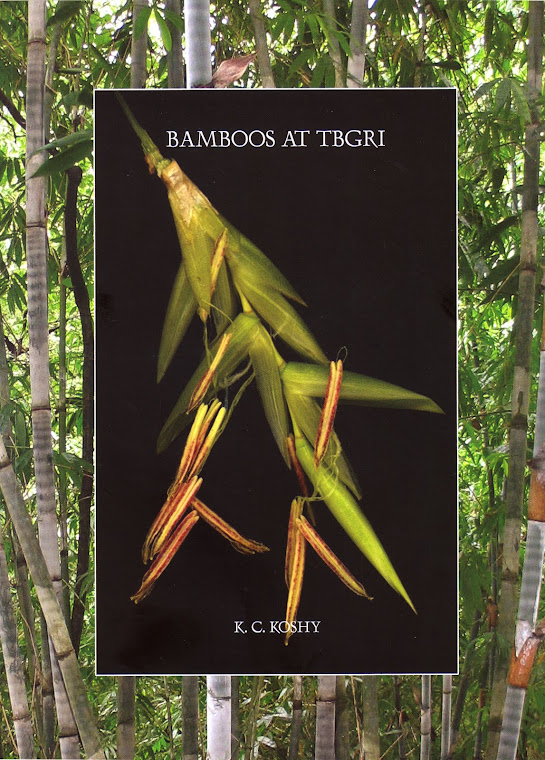
Koshy, K.C.2010
Wednesday, 25 January 2012

Tuesday, 24 January 2012
Links to Book Reviews
Book Reviews of BAMBOOS AT TBGRI appeared in 17 Journals,13 may be found in the following links:
1. Gardens' Bulletin Singapore 62(2):337-338.2011
2. Botanical Journal of the Linnaen Society 167:131.2011
3. Kew Bulletin 66:195-196.2011
http://www.springerlink.com/content/d63588188004h768/
4.Economic Botany 65(4): 430. 2011
www.springerlink.com/index/5728544PN9324155.pdf
5. Plant Science Bullletin 57(3): 121 2011
www.botany.org/PlantScienceBulletin/psb-2011-57-3.pdf
6.Plant Diversity and Resources 33(4):375. 2011
http://journal.kib.ac.cn/EN/article/showArticleFile.do?attachType=PDF&id=2995
7.Bangladesh Journal of Plant Taxonomy 18(2):209-210.2011
http://banglajol.info/index.php/BJPT/article/view/9309/6861
8. Nelumbo 52:156.2010
http://164.100.52.111/nelumbo52.pdf
9. Current Science-Indian Academy of Sciences 100(5):770.2011
10.Rheedea 20(2):76.2010
http://www.iaat.org.in/Rheedea20_76.pdf
11. NON-WOOD NEWS No.23, 68.2011
http://www.fao.org/docrep/015/i2455e/i2455e07.pdf
14. Hornbill Jan-March 31.2011
15. Phytotaxonomy 11:36.2011
16. Indian Forester 137 (9):1137.2011
17. TAXON 60 (1):310.2011(Reviews and notices)
1. Gardens' Bulletin Singapore 62(2):337-338.2011
2. Botanical Journal of the Linnaen Society 167:131.2011
3. Kew Bulletin 66:195-196.2011
http://www.springerlink.com/content/d63588188004h768/
4.Economic Botany 65(4): 430. 2011
www.springerlink.com/index/5728544PN9324155.pdf
5. Plant Science Bullletin 57(3): 121 2011
www.botany.org/PlantScienceBulletin/psb-2011-57-3.pdf
6.Plant Diversity and Resources 33(4):375. 2011
http://journal.kib.ac.cn/EN/article/showArticleFile.do?attachType=PDF&id=2995
7.Bangladesh Journal of Plant Taxonomy 18(2):209-210.2011
http://banglajol.info/index.php/BJPT/article/view/9309/6861
8. Nelumbo 52:156.2010
http://164.100.52.111/nelumbo52.pdf
9. Current Science-Indian Academy of Sciences 100(5):770.2011
10.Rheedea 20(2):76.2010
http://www.iaat.org.in/Rheedea20_76.pdf
11. NON-WOOD NEWS No.23, 68.2011
http://www.fao.org/docrep/015/i2455e/i2455e07.pdf
12.Journal of the Botanical Research Institute of Texas 5(1):320.2011
http://brit.org/sites/default/files/public/BRIT%20Press/JBRIT5(1)/Reviews/320_BookNotices.pdf
13.Blumea 57:195. 2012
http:// www.osodresie.wikispaces.com/file/view/p195-198+book+reviews.pdf
15. Phytotaxonomy 11:36.2011
16. Indian Forester 137 (9):1137.2011
17. TAXON 60 (1):310.2011(Reviews and notices)
Monday, 16 January 2012
Economic Botany, 65(4):430. 2011
Economic Botany, 65(4), 2011, p. 430.
© 2011, by The New York Botanical Garden Press, Bronx, NY 10458-5126 U.S.A.
Bamboos at TBGRI [Tropical Botanic Garden and Research Institute]. Koshy, K. C. 2010. Tropical Botanic Garden and Research Institute, Palode, Thiruvananthapuram 695562 Kerala, India; http://www.tbgri.in/tbgri/Bambo/ bamboo.htm. 104 pp. (paperback). Rs 800.00; USD 30.00. ISBN 978-81-920098-0-3.
This is a combined catalog and guide to one of India’s largest collections of living bamboos. TBGI (Tropical Botanic Garden and Research Institute) is located in the very south of India in the foothills of the Western Ghats in the state of Kerala. The Bambusetum (a living bamboo collection) is now about 25-years-old and flourishing under the guidance of Dr. K.C. Koshy. Two groups of giant tropical monocotyledons— palms and bamboos—are economically important but do not lend themselves to traditional herbarium collections. They are massive and often are identified by features of habit that cannot be documented in a dried pressed specimen. For ethnobotanical study and for understanding their biology and reproduction, living collections are priceless. Moreover, many bamboos have long and irregular flowering cycles. It is difficult to compare vegetative samples with flowering samples of a plant that flowers only once after many years of growth. The 68 species in 15 genera originate mainly from South India and Himalayan areas but also include many Asian species. Species are referenced in an index to scientific names and synonyms. In addition, there are 12 hybrids that were produced at TBGRI by the author and still under selection.
The historical development of the collection, the personalities involved in its establishment, methods of propagation, and its management are documented. The collection was built upon both cuttings from older gardens and newer propagules from field collecting trips by TBGRI throughout the Western Ghats and the regions of northern India. A detailed two-page planting map is presented, although the extreme reduction in size limits usefulness for locating accessions and canopy trees within the 6.6 hectares (16 Acres). The bulk of the book (67 pages) and the most useful part is the listing of taxa with nomenclature, accession details, location of herbarium vouchers, and often descriptions of habit, flowers, and flowering notes. The book is well illustrated with some 131 color images: including habit, flowers and fruit. The color is well printed on glossy paper.
The book will be of greatest use to a visitor of the collection in Kerala. However, any person interested in bamboos will find this a valuable resource for what is available at this major Indian bambusetum. Illustrations of bamboo habits and reproductive details will interest the bamboo enthusiast. The attractive cover images make it plant catalog with coffee table appeal.
JACK B. FISHER
FAIRCHILD TROPICAL BOTANIC GARDEN,
CORAL GABLES, FL, USA
JACKBFISHER@COMCAST.NET
Wednesday, 9 November 2011
Plant Science Bulletin 57(3):121.2011
Bamboos at TBGRI.
Koshy, K.C.2010. ISBN 978-81-920098-0-3 (paperback) 104 pp. Tropical Botanic Garden Kerala , India
This is a wonderful book on a developing bambusetum, a living collection of bamboo species. The site is part of the Tropical Botanic Garden Kerala , India Ghat Mountains
Koshy tells the story of the project in a straightforward fashion, discussing the obstacles encountered and the successes achieved. He notes the advantages of a bambusetum: the accessibility of a collection for scientific study including the flowering cycle, the availability of material for farmers or foresters, and the possibility of studying the other species which form communities with bamboo. He also describes bamboo-collecting expeditions and their fruits.
Among other notes on these plants, Koshy makes clear the major hurdle to studying bamboos: they flower very rarely, and in many cases only once in a life cycle. Since the vegetative forms of many species look very similar to each other, it was difficult for Koshy to even know how many species he had, particularly at the early stages of the project. In addition, such infrequent flowering makes it not easy to create hybrids, though his team has managed to produce twelve, which are all listed here.
Also included are short discussions about the roles a number of botanists played in developing the collection. There is even a short section on the VIPs who have visited the bambusetum, including Ghillian Prance, then Director of the Royal Botanic Gardens at Kew .
Following this introductory material, Koshy then presents the heart of the book, an annotated list of the bamboos species at TBGRI. Many of the descriptions, which include information both on the living plants and herbarium specimens, are accompanied by photographs. There are data here on when the plants were accessioned, on flowering if known, and statistics on length of internodes and the size of leaves. These descriptions are brief and are presented more as lists than narratives.However, they would be useful to those studying bamboos and having some knowledge of the family.
After this section, which takes up about three quarters of the book, there is information about the TBGRI’s bamboo museum and about its nursery. The book ends with a discussion of future plans as well as a list of references, and finally an index to bamboo scientific names.
This 104-page paperback is beautifully produced with many photographs, including a number of full-page ones showing close-ups of particular species as well as views of the TBGRI. The volume was obviously a labor of love for Koshy and for the Garden. It is not a general introduction to bamboos, but it would be a shame if it were missed by someone seeking to learn more about these plants. The introductory material as well as the explanations of how hybrids were developed provide excellent general descriptions. The detailed information on each species would be interesting to an expert, and in the years ahead it will serve as documentation for what this bambusetum held at a particular moment in its history.
-Maura Flannery, Department of Biology, St. John’s
www.botany.org/PlantScienceBulletin/psb-2011-57-3.pdf
Thursday, 1 September 2011
Plant Diversity and Resources 33(4):375.2011
Plant Diversity and Resources 33(4):375.2011
书评
Koshy, K. C. (2010). Bamboos at TBGRI. Pp. 104,128 colour photographs,1 painting,1 graph,1 map. India: Kerala, Tropical Botanic Garden and Research Institute (TBGRI), Palode, Thiruvananthapuram 695562. Price Rs. 600; US $ 30 (postage & handling free). ISBN 978-81-920098-0-3 (soft cover).
摇摇
This book tells the story of the establishment of a bambusetum at the Tropical Botanic Garden and Research Institute in the state of Kerala in southern India. Started in 1987 by the author, it could be held up as a model of thoroughness in building up a living bamboo collection. Scrupulous care was taken to document all introductions and their location in the Garden. Although only 68 species are represented, great effort was taken to acquire a diversity of genotypes within them amounting to 933 different accessions. This diversity is
valuable for understanding specific variability, flowering cycles, and selecting the best clones for different uses. It is also indispensable for bamboo breeding which they have ventured into and have successfully produced 12 hybrids. For each species, the information on nomenclature, description, distribution, live collections, location, planting date, propagule and provenance, dried specimens are given in detail. The species descriptions are focused on the vegetative characters, which are very useful for identification. Many photographs are helpful but some species don忆t have close up pictures of the new shoots which are so important in identifying species in a vegetative state. A number of species of Pseudoxytenanthera and Ochlandra, native to south India, which are seldom illustrated in bamboo books, are depicted here. This book is a wonderful record of the live bamboo collection at TBGRI and a useful reference for understanding the conservation of the bamboo genetic diversity. It is a very useful handbook for bamboo researchers, collectors, growers as well as amateurs.
Prof. Dr. Xia Nianhe
Curator of the Living Collection
South China Botanical Garden
Chinese Academy of Sciences
Friday, 19 August 2011
Botanical Journal of the Linnean Society, 2011, 167, 131.
Botanical Journal of the Linnean Society 167: 131.2011
Book Reviewboj_1130 131
Bamboos at TBGRI by K. C. Koshy. Palode, Thiruvananthapuram, Kerala: Tropical Botanic Garden and Research Institute, 2010. 104 pp. Paperback.ISBN 978-81-920098-0-3. US$30.
Bamboos are among the most rapidly growing plants on earth and they are an important renewable resource, because their stems are tough but flexible and are used widely for construction and paper production. A collection of bamboos, a bambusetum, can function as a source for dissemination of this renewable resource and the one at the Tropical Botanic Garden (TBGRI) in Kerala, India, has fulfilled this purpose very well.
Dr. Koshy has studied bamboos at TBGRI in Palode since 1987, resulting in the establishment of a fine collection of bamboos, many of which were collected from the wild. This well-illustrated book summarizes his work and describes the establishment and history of the bambusetum.
Apart from the living collections of bamboos (spread over 6.59 hectares, containing 933 accessions belonging to 68 species), there is also a small herbarium and spirit collection. All accessions (live collections, dried specimens and spirit collections) are mentioned after a detailed description and distribution of each species. All species described are accompanied by a habit picture and sometimes by additional pictures showing the flowers, seeds or stem details.
This book provides a good general overview of tropical bamboos (although it is by no means monographical and the author did not intend to include all known species of bamboos), and it shows how a botanical collection (in this case a bambusetum) can be used to disseminate interest in botanical diversity by involving local communities that may benefit from it.
Anyone interested in establishing a bambusetum in the Tropics, or who wants to identify an unknown bamboo in a garden or in the field, will find this book a most useful guide. It is attractively produced and is affordably priced.
MAARTEN J. M. CHRISTENHUSZ
Botanical Journal of the Linnean Society, 2011, 167, 131.
© 2011
Tuesday, 26 July 2011
KEW BULLETIN VOL. 66: 195–196 (2011) by Maria S. Vorontsova
© The Board of Trustees of the Royal Botanic Gardens, Kew , 2011
Book Reviews
(Edited by B. M. Spooner)
K. C. Koshy. Bamboos at TBGRI. Pp. 104, 128 colour photographs, 1 painting, 1 graph, 1 map. India Tropical Botanic Garden
Bamboos are commonly seen but mysterious, with some species able to grow one metre a day, and many species not flowering for over 100 years until mass blooming is followed by mass death. In the twenty-first century we still have no record of flowers for many species and we are seemingly no closer to understanding bamboo reproductive systems or the evolutionary driving forces behind them. This worrying lack of knowledge combined with their economic importance make the study of bamboos a priority. This book demonstrates some of the extensive and valuable work funded by the Indian government.
This is a catalogue of 68 bamboo species and 933 live germplasm accessions at the Tropical Botanic Garden India
This is an attractive publication with high quality graphic design and numerous photographs. It succeeds in its stated aim of promoting bamboos and the bamboo collection at TBGRI to the amateur reader. For professionals working with bamboos, the accession and specimen information would perhaps be easier to use in a searchable electronic format, especially if it was made available online. As no modern guide exists to the bamboos of India New World bamboos.
The reviewer would like to thank Dr Jatmi Dransfield for valuable discussion that has greatly contributed to this review.
Maria S. Vorontsova
References
Clayton, W. D., Harman, K. T. & Williamson, H. (2010).GrassBase — The Online World Grass Flora. http://www.kew.org/data/grasses-db.html. [accessed 24 January 2010 ]
Judziewicz, E. J., Clark, L. G., Londono, X. & Stern, M. J. (1999). American Bamboos. Smithsonian Institution Press, Washington DC
Subscribe to:
Posts (Atom)